
Chatham County Projected and Actual Release Dates
The North Carolina Department of Adult Correction uses the exact label Projected Release Date within an individual Offender Public Information sentence or incarceration block. It may also show Actual Release Date. Projected is an administrative estimate associated with a particular sentence period. Actual records the release event that occurred for that period. Neither field should be read apart from the offense, sentence number, service status, and current top-level status.
A person with several sentences can have several projected dates. Select the block that matches the offense and active service period instead of copying the first date on the screen. After release, read Actual Release Date with Inmate Status and Probation/Parole/Post Release Status. A person may have left prison and entered active post-release supervision, so physical release is not the same as correctional discharge.
The NCDAC date applies to state prison custody. It is not a promised release time from the Chatham County Detention Center. The county’s live roster publishes a Booked Date but no projected-date calculation, actual release date, or release reason.
Find a Chatham County Projected Release Date
Begin by classifying the custody episode. A state-prison sentence belongs in NCDAC. A local jail sentence belongs with the judgment and Chatham detention records. A pretrial stay has no sentence endpoint to calculate. This division prevents a state projection from being attached to a jail-only booking.
- Check the Chatham Sheriff current roster if the person may still be at the Detention Center. A match means the official feed currently presents local custody.
- For a North Carolina prisoner, open the NCDAC general offender search and search by offender number or carefully matched identifying facts.
- Open the individual record. Match the sentence number, offense, dates, and service status before reading Projected Release Date.
- Read the top-level inmate and supervision fields. A post-release/parole status can show that prison ended while supervision continues.
- For a Chatham jail sentence, obtain the judgment from the Clerk and ask detention how the credited time and applicable rules are being applied.
- Near the expected date, check the current record again. After the event, use Actual Release Date or the Sheriff release record rather than an old projection.
The NCDAC Inmate Release Search is useful after a state release. It can filter by Chatham, month, year, or surname and exposes Release Date and Type Of Release. The meaning of “release county” is not defined on its form, so do not assume a Chatham filter means release from the county jail. Open the person’s individual record and verify the sentence.
Note: Record the offender number, sentence number, offense, service status, projected date, and access date so the estimate can be checked later.
NCDAC Release Fields for Chatham County
NCDAC has two complementary tools. The general offender search includes current and historical state prisoners and supervisees, including people whose status is inactive. The separate release search is release-first and lists selected release events. Neither tool includes a person whose only confinement was at the Chatham County Detention Center.
| Projected Release Date | A calculated estimate tied to a sentence or incarceration block, not a guaranteed appointment. |
|---|---|
| Actual Release Date | The recorded end of prison confinement for the relevant sentence period. |
| Sentence number and offense | Identify which block the projected or actual date belongs to. |
| Service status | Helps show whether the selected sentence period is active or complete. |
| Inmate Status | Shows the person’s current relationship to NCDAC prison custody. |
| Probation/Parole/Post Release Status | Shows whether community supervision continues after prison release. |
| Type Of Release | Appears in the separate release-search result and characterizes the state release event. |
The official NCDAC release-search form is shown below. Its Chatham, month, year, and surname controls are useful for finding a state event, but the result must be reconciled with the individual sentence record.
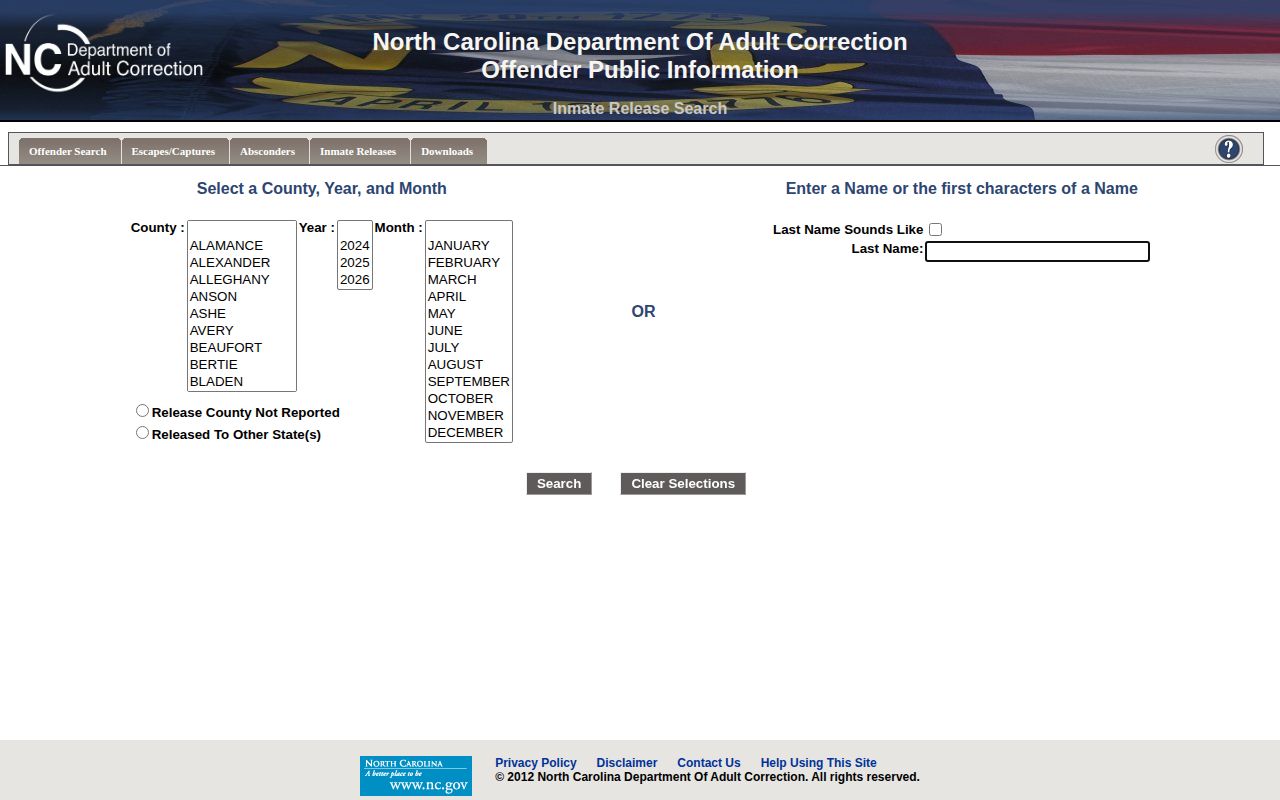
The screen is a state-corrections release route, not a Chatham jail release list. For a named person, match the offender number, Release Date, primary offense, and Type Of Release before relying on the row.
Chatham County Release Dates and the Minimum Term
North Carolina structured sentencing does not support a one-step subtraction from the maximum term. Under G.S. 15A-1340.13(d), a person serving an active structured-sentencing felony punishment must serve the minimum term imposed. Earned-time credit can reduce the maximum term, but it cannot reduce confinement below that judicially imposed minimum.
The felony minimum and maximum framework appears in G.S. 15A-1340.17. The judgment supplies the terms; NCDAC applies the sentence structure, eligible credits, sentence relationships, and later events to its administrative projection. A reader should not try to rebuild that projection from a charge label or a single number in a docket.
G.S. 148-13(a1) directs NCDAC to adopt rules for earning and forfeiting time credits on activated felony and misdemeanor sentences. Subsection (e) distributes earned-time and good-time rules to local jail administrators for sentenced jail prisoners. That does not create one universal credit for everyone in Chatham custody. Pretrial detainees are not serving an activated sentence, and different sentence regimes can apply.
Note: Earned time can affect an eligible sentence calculation, but it cannot be used to move a structured felony below the court-imposed minimum term.
Chatham County Prison Release and PRS Endpoints
Post-release supervision creates two dates that are easy to confuse. Under G.S. 15A-1368.2(a), release to PRS is set through statutory subtraction from the maximum term, with earned-time adjustments and the minimum-term floor. The periods depend on the felony class and whether a special maximum applies. Subsection (c) sets the related PRS periods, and subsection (f) provides for sentence termination when PRS is completed.
The first endpoint is release from prison to PRS. The second is successful completion of supervision and sentence termination. An NCDAC result showing POST RELEASE/PAROLE and ACTIVE means the person is outside prison but has not completed state correctional control. The Chatham County probation and parole page explains how to verify that supervision status.
Traditional discretionary parole is a separate process for the limited population still eligible, generally tied to offenses before October 1994 and a narrow later juvenile-life category. Monthly Parole Commission result sheets are retrospective decisions, not projected-release calendars. A parole eligibility date, review result, prison projection, and PRS end date answer different questions.
Why Chatham County Release Is Not an 85% Formula
The common claim that every North Carolina prisoner serves 85 percent is not a reliable calculator. The controlling rule for a structured-sentencing felony is the judicial minimum-term floor, combined with the minimum and maximum framework, PRS subtraction, eligible earned time, sentence relationships, and events that occur after judgment. NCDAC’s projected date incorporates the record that applies to the person.
The shorthand does not fit every offense, an older pre-1994 sentence, an impaired-driving sentence, a local jail term, a life sentence, a disciplinary-credit change, or a record with several sentence blocks. Concurrent and consecutive terms can also change how a date is read. The safe statement is that eligible credits generally cannot reduce a structured felony below the imposed minimum.
A federal BOP projected date is computed under federal law and can change after federal credit recalculation. It does not control a North Carolina sentence. Likewise, a county-jail booking date is not a substitute for either state or federal sentence data.
What Changes a Chatham County Release Date
A projection can move because the sentence record itself changes or because the credit and custody facts change. A date seen on an old screen should not be treated as fixed. The following factors are documented reasons to recheck the official record.
| Factor | Effect on the projection |
|---|---|
| Sentence correction or new judgment | Changes the legal terms NCDAC must apply. |
| Concurrent or consecutive resolution | Changes how multiple sentence periods relate to one another. |
| Jail credit posted | Adds verified time confined to the calculation where applicable. |
| Earned time gained or forfeited | Adjusts the eligible maximum-side calculation, subject to the minimum floor. |
| Disciplinary event | Can cause eligible credit to be lost or the record to be recalculated. |
| Appellate or other court relief | Can alter or remove part of the judgment used for the estimate. |
| Another agency hold or transfer | May mean release from one custodian is not return to the community. |
A detainer does not necessarily rewrite the NCDAC sentence date, but it can change what happens at that endpoint. The person may leave one agency and immediately enter another. For that reason, read the event label and receiving-agency information instead of describing all custody endings as community release.
Chatham County Jail Release Date Calculation
For a sentence served at the Chatham County Detention Center, begin with the official judgment, verified credit for time confined, and the jail’s application of the law. The public roster offers Booked Date only. Research found no Chatham projected-date calculator, local sentenced-jail credit chart, standard release hour, weekend-advance rule, or published holiday procedure.
Obtain the judgment through the Chatham County Clerk of Superior Court. Then contact the Detention Center at 919-545-7802 for an operational question or submit the Sheriff public-record request for the booking and release record. Ask for existing fields, such as actual release time, release type, and receiving agency, rather than asking the Sheriff to create a custom calculation.
A pretrial detainee has no fixed sentence date. A court may authorize release through bond, recognizance, dismissal, a custody release, or a Pretrial Services order, but authorization is not proof that jail processing is complete. The actual Sheriff timestamp is the event record. A transfer also ends Chatham custody without establishing that the person returned to the community.
Confirm a Chatham County Release Date
Near the projected date, reopen the current NCDAC individual record and check the same offender and sentence numbers. If the date has passed, prefer Actual Release Date and current supervision status over a saved projection. NCDAC warns that public data can contain technical or human error, so an official record request is appropriate when the web result is ambiguous or the date must be documented.
For a jail case, compare the court judgment, Sheriff release event, and any receiving-agency field. For a state-prison case, compare NCDAC Actual Release Date, the present inmate or supervision label, and the judgment. NC SAVAN or VINELink can provide a custody-change alert, but a notification should be checked against the agency record because data can lag and transfer alerts require careful reading.
The Chatham County VINELink inmate search guide describes the specific-person alert steps and the need to register again after a transfer. A stopped alert is not proof of community release, and a no-result does not establish that custody ended.